

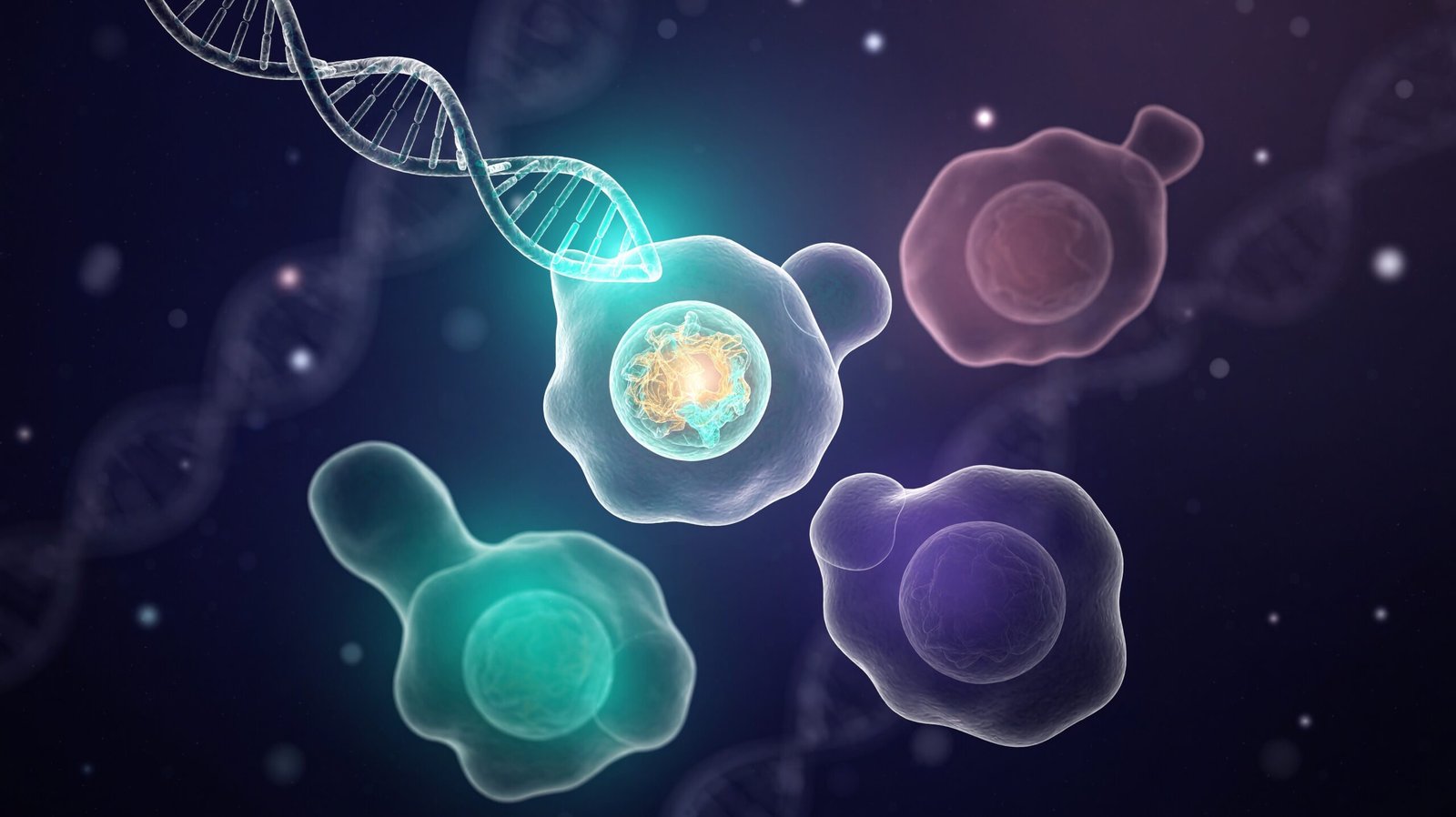
Your heart cells, brain cells and immune cells all carry the same DNA. So why does one tiny DNA change cause trouble in some cells and nothing in others?
That’s the question Google DeepMind’s new model, AlphaGenome 2, is built to help answer. It’s a real step forward. But some summaries make it sound like an AI that diagnoses disease from DNA. It isn’t. Let’s go through what it actually does.
Quick answer
What is AlphaGenome 2? A DNA sequence model from Google DeepMind that predicts how DNA variants change gene activity in specific human cell types and cell states.
When was it announced? November 11, 2026.
Can it diagnose disease? No. It’s for research only and isn’t validated for clinical or diagnostic use.
Who can use it? Researchers, for free, for non-commercial work through the AlphaGenome API. Commercial research is in private preview.
What is the “dark genome”?
Only about 2% of human DNA codes for proteins. The other roughly 98% is non-coding. Much of it works like a control panel, switching genes on and off in different cells.
“Dark genome” is a popular nickname for that part, not DeepMind’s term. Many disease-linked DNA variants sit there. And that makes them hard to explain.
What’s new compared with the first AlphaGenome?
AlphaGenome 1 looked at a long stretch of DNA and predicted lots of tissue-level signals at once. DeepMind says that spread the model thin and made closely related cell types hard to tell apart.
AlphaGenome 2 works differently. It’s a conditional model. You pick one condition, like a cell type, tissue or cell state, and it predicts what a DNA sequence does there.
- Bring your own cells. A cell encoder can turn a researcher’s own single-cell data into a condition. No retraining needed.
- Fill in gaps. Give it one measurement, like gene activity, and it can predict others, like chromatin accessibility.
- New readout. DNA methylation, along with gene expression, splicing and chromatin accessibility.
- More data. Trained on more than 100 million single-cell profiles from human and mouse samples.
How good is it?
On a single-cell immune benchmark called TenK10K, covering 28 cell types, DeepMind reports:
- Causal variants found: 30%, against 16% for the earlier model fine-tuned on single-cell data
- Direction of effect (up or down): 43% correct, against 23%
That’s the “nearly twice as many variants” you’ll see in headlines. Those are DeepMind’s reported numbers, at 90% precision.
Read it the other way too. Even at its best, the model finds under a third of the likely causal variants on that test. And the benchmark covers immune cells only, so the result may not carry over to other cell types.
What did it show on real diseases?
Two examples, both illustrative:
- Inflammatory bowel disease. It singled out a variant far from a gene called ETS2 and linked it to gut macrophages. That matches a mechanism already shown in experiments.
- COVID-19 vaccine study. It told activated T cells from resting ones, and predicted a variant linked to severe COVID-19 matters more in activated cells.
It also gives researchers precomputed scores for more than 6.8 million variants across 510 human conditions. That helps teams without big computing budgets.
Does it “predict disease” like some summaries say?
Not in the way it sounds.
- You input a DNA sequence plus a chosen cell condition. It outputs molecular predictions: gene activity, splicing, accessibility and methylation.
- It doesn’t output a diagnosis or a personal risk score.
- It helps researchers narrow down which variants, genes and cell types might drive a trait, including traits like height and type 2 diabetes.
- “Cutting years of lab work to seconds” is too strong. Predictions are hypotheses. They still need lab testing.
What are the limits?
DeepMind’s paper, as reported, is upfront about them:
- It can underestimate effects at very distant regulatory elements, or ones that act after transcription.
- Short-lived, stimulated and disease states are underrepresented in the training data.
- It’s hard to separate fine neuron subtypes.
- Its cell conditions come from steady-state snapshots, which capture correlations, not cause and effect.
- It’s unclear how well it predicts knockouts, overexpression or fast cell-state changes.
- Each condition needs a separate prediction, so it costs more computing than fixed-output models.
How can you get access?
- Non-commercial research: available now through the AlphaGenome API. Documentation says non-commercial use is free, with rate limits that vary by demand.
- Commercial research: private preview
- Tutorials: Colab notebooks for expression conditioning
- Coming: “AlphaGenome 2 Skills” for Google Antigravity
- Extra quota: researchers can submit use cases by November 30
DeepMind’s page doesn’t mention open weights or a specific license.
Who’s involved?
DeepMind names the Wellcome Sanger Institute as an ongoing collaborator. Genomics PLC plans to use it in its Mystra platform. Cambridge’s Sarah Teichmann praised how it adapts to new single-cell data without retraining. Those are supportive comments from partners. The coverage I read includes no independent academic review.
What we still don’t know
- How well it works outside immune cells
- How independent labs’ tests compare with DeepMind’s reported numbers
- Whether model weights will ever be released
- How it handles disease states underrepresented in training data
Why does this matter?
Most disease-linked DNA variants don’t sit inside genes. Figuring out which ones matter, in which cells, is slow and costly. A model that narrows the list gives lab scientists a better starting point.
That’s useful. It’s also a first step. This is a research tool, not a medical test. If you have health concerns, talk to a doctor, not a model.
FAQ
What is AlphaGenome 2?
It’s Google DeepMind’s DNA sequence model that predicts how variants affect gene activity in specific human cell types and states.
When was AlphaGenome 2 released?
November 11, 2026.
Can AlphaGenome 2 diagnose diseases?
No. It’s for research only and hasn’t been validated or approved for clinical or diagnostic use.
What is the dark genome?
It’s a nickname for the roughly 98% of human DNA that doesn’t code for proteins. Much of it regulates genes.
How is it different from AlphaGenome 1?
It predicts for one chosen cell type or state at a time and can adapt to a researcher’s own single-cell data without retraining.
Is AlphaGenome 2 free?
Non-commercial research use through the API is free. Commercial research is in private preview.
Is it open source?
DeepMind’s announcement doesn’t mention open weights or a license.
Bottom line
AlphaGenome 2 is a sharper tool for a hard problem: working out which DNA changes matter, and in which cells. The reported gains are real but modest in absolute terms, and they come from DeepMind’s own tests.
It points scientists toward better questions. It doesn’t answer them for you, and it doesn’t tell anyone what disease they have.