

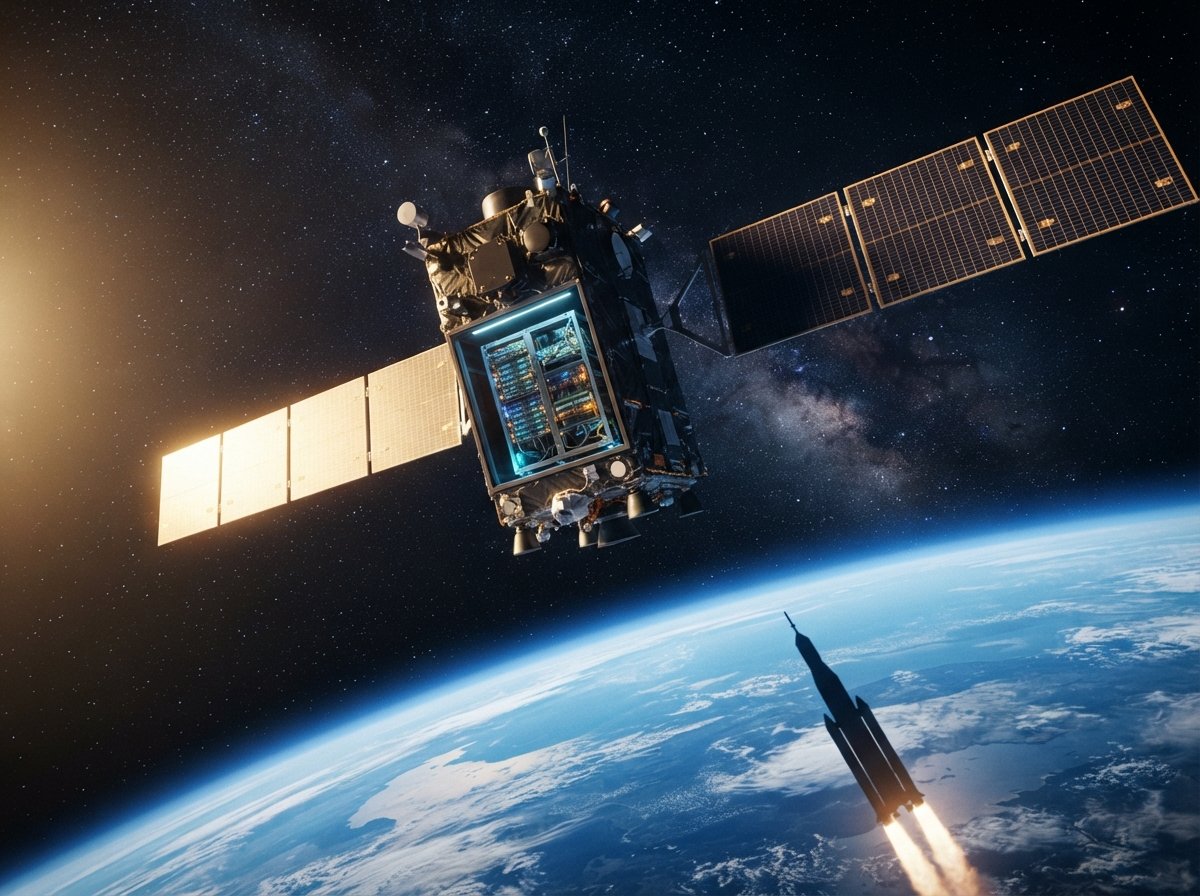
Google wants to put AI data centers in space. Not a joke. It just signed a rocket deal.
The launch partner? Blue Origin, owned by Jeff Bezos. Let’s see what’s confirmed and what’s still a long shot.
Quick answer
On November 19, 2026, Google and Blue Origin announced a launch services agreement for Project Suncatcher. Suncatcher is Google’s research project on solar-powered satellites carrying its TPU AI chips. The first dedicated heavy-lift launch on a New Glenn rocket is targeted for Q1 2029. Each satellite is planned to carry roughly the compute of a data center rack, in sun-synchronous orbit. The 2029 date is a target, not a firm date. Google calls Suncatcher a “long-term moonshot.”
What is Project Suncatcher?
Google’s research project to run machine-learning compute in orbit. The idea: satellites powered by sunlight, carrying Google TPUs, linked together.
It’s early-stage research. Not a product. You can’t rent space compute from Google today.
What did Google and Blue Origin agree?
- A launch services agreement, announced November 19, 2026 (not November 21).
- A dedicated heavy-lift launch on New Glenn, targeted for Q1 2029.
- Satellites with roughly “the capacity of a data center rack” each, per Google’s Travis Beals.
- Deployment to sun-synchronous orbit.
Not disclosed: how many satellites fly, and the price. You may see “81 satellites” online. That number comes from Google’s 2025 research, which modeled an illustrative 81-satellite constellation. It is not an announced launch plan.
What is New Glenn?
Blue Origin’s heavy-lift rocket. Published design specs put it at about 322 feet (98 meters) tall, with roughly 45 metric tonnes to low Earth orbit and a 7-meter fairing. The first stage is reusable. Blue Origin’s announcement itself didn’t list specs, so treat these as general rocket figures.
Did Google really run an AI prompt in space?
Yes, on a small prototype. Here’s the timeline:
- A single prototype, built with Planet, launched October 1, 2026 on a SpaceX Transporter-18 rideshare.
- Google announced the result on October 30. It ran Gemma 4, an open model, on a data-center-class TPU in orbit.
- Google sent up a prompt for a haiku about being in space. The poem was beamed back as the satellite passed over Svalbard, Norway.
Careful with the claim. This was inference, not training. Google says it’s the first AI response “from a data center class TPU in orbit,” not the first AI ever run in space. No performance data, chip count or cost was published.
Is this really a Google vs SpaceX vs Blue Origin fight?
Partly speculation. The sources I read don’t say Google’s launch partners will block it.
What’s reported: SpaceX has experimented with orbital data centers, and startups like Starcloud are chasing the idea. Notice too that Google’s prototype already flew on a SpaceX rideshare. So Google is using more than one launch provider. Whether rivals would favor their own payloads is an analyst-style question, not a confirmed conflict.
What are the big challenges?
- Heat: chips must shed heat in space with pipes and radiators. Scaling that up is hard.
- Radiation: it can cause bit flips and errors.
- Cost: one Falcon 9 launch costs around $74 million, and its payload can barely cover a small server room’s hardware, per Engadget.
- Debris: more satellites raise the risk of collisions in low Earth orbit.
- Timeline: a Carnegie Mellon professor says scaling a large network would take years and big money.
And the schedule has slipped. Google’s 2025 plan called for two prototypes by early 2027. Only one has flown. Twin interconnected satellites are now the 2027 goal.
What we still don’t know
- How many satellites launch in 2029.
- Thermal and radiation test results from orbit.
- Cost per unit of compute versus Earth data centers.
- Whether the 2029 date holds.
FAQ
What is Project Suncatcher?
Google’s research project for solar-powered satellites carrying TPU chips for AI compute in orbit.
When will Suncatcher launch?
The first dedicated New Glenn launch is targeted for Q1 2029. It’s a target, not a firm date.
Why did Google pick Blue Origin?
Google called the dedicated launch a “crucial milestone on our roadmap.” New Glenn offers heavy-lift capacity and large payload volume.
Has Google already run AI in orbit?
Yes. A prototype ran Gemma 4 on a TPU and sent back a haiku, announced October 30, 2026.
Are space data centers practical?
Not yet. Heat, radiation, launch cost and debris are open problems.
Can I use it?
No. It’s research, not a service.
Bottom line
The deal is real. The haiku test is real. The 2029 launch is a plan.
Orbital AI is a fascinating bet. But it’s years from competing with a normal data center. Watch the 2027 twin-satellite test.