

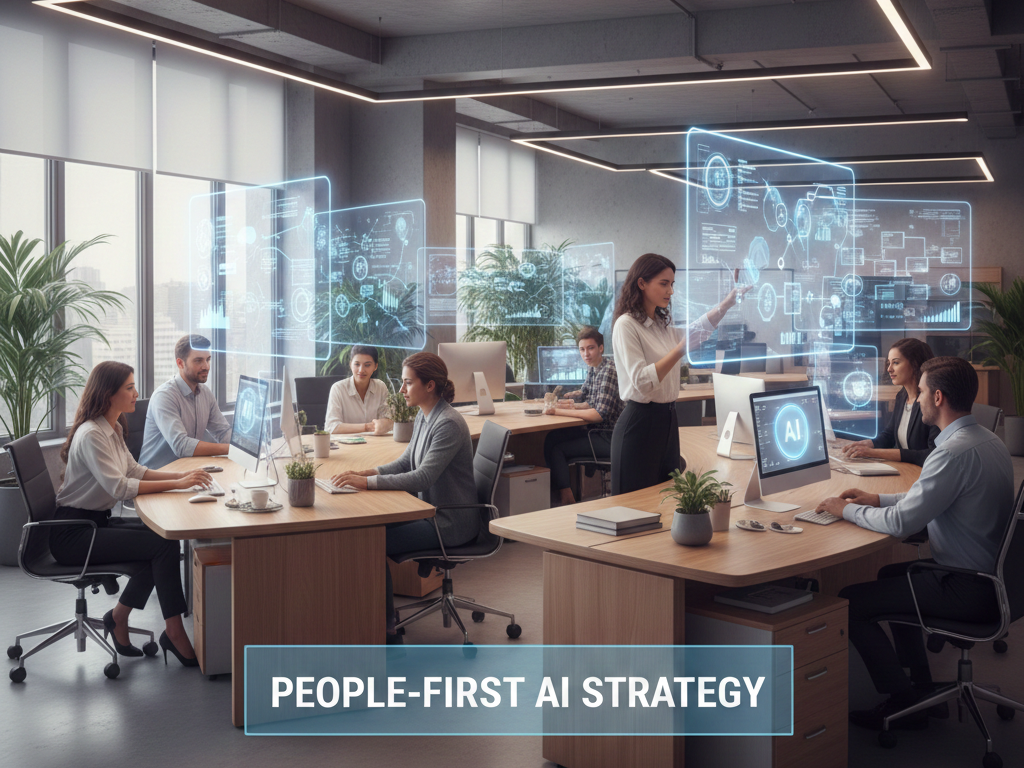
Ever wondered how you can turn a hectic workday into a smooth, well-organized operation? Artificial intelligence is rapidly transforming the modern workplace, offering powerful ways to improve efficiency while keeping people at the center of every process. When applied thoughtfully, AI at work doesn’t replace human skills—it strengthens them.
A People-First Approach to AI at Work
The most effective use of AI begins with a people-first mindset. AI works best when it enhances what humans already do well, such as creativity, decision-making, and collaboration. Instead of viewing AI as a replacement, successful organizations see it as a supportive partner that helps teams focus on meaningful, high-value work.
Understanding AI Augmentation
AI augmentation focuses on improving the quality or speed of work through intelligent assistance. Most roles involve a mix of simple and complex tasks. For example, responding to routine emails can take up valuable time, while brainstorming ideas or solving strategic problems requires human insight.
AI tools can assist with repetitive or time-consuming activities, allowing professionals to complete tasks faster and with greater accuracy. By reducing manual effort, AI augmentation helps employees dedicate more energy to creative thinking, problem-solving, and collaboration.
How AI Automation Streamlines Workflows
AI automation goes a step further by completing tasks with minimal or no user intervention. Consider a customer support team handling hundreds of daily inquiries. AI systems can automatically sort emails by urgency, draft responses for low-priority messages, and learn from previous interactions to improve accuracy over time.
With automation managing routine work, employees can focus on complex issues that require empathy, judgment, and personal attention. This balance not only improves productivity but also enhances job satisfaction.
Finding the Right Balance Between Augmentation and Automation
Striking the right balance between AI augmentation and automation takes time, experimentation, and thoughtful planning. Over-automation can reduce flexibility, while underutilizing AI may limit productivity gains. The key is to align AI use with human strengths and business goals.
Organizations that succeed in this area stand out by applying AI strategically across their products, services, and job roles.
AI as a Collaborative Workspace
Think of AI as part of a collaborative ecosystem rather than a standalone tool. For example, when a public relations professional uses AI to help draft press releases, human oversight remains essential. Managers coordinate resources, editorial teams ensure brand voice consistency, and legal teams verify compliance with regulations.
This collaborative approach ensures that AI-generated output meets quality standards and aligns with organizational values.
Inclusive and Adaptive AI Integration
Integrating AI at work should always be inclusive. Input from diverse roles and departments leads to better outcomes and more reliable systems. As AI continues to evolve, learning and adaptation become critical.
By understanding how AI works and how it can support daily tasks, professionals can actively contribute to meaningful discussions and responsible implementation strategies.
Final Thoughts
AI at work is not about replacing people—it’s about empowering them. With a people-first approach, the right mix of augmentation and automation, and strong collaboration across teams, AI can transform everyday workflows into smarter, more efficient, and more fulfilling experiences.