

Introduction
Search is changing fast.
A few years ago, people opened Google, typed a keyword, clicked a website, and read the answer.
Now the behavior is different.
People ask ChatGPT.
They use Google AI Overviews.
They ask Gemini, Copilot, Perplexity, and other AI tools.
And many times, they get the answer without opening any website.
This is where GEO vs SEO becomes important.
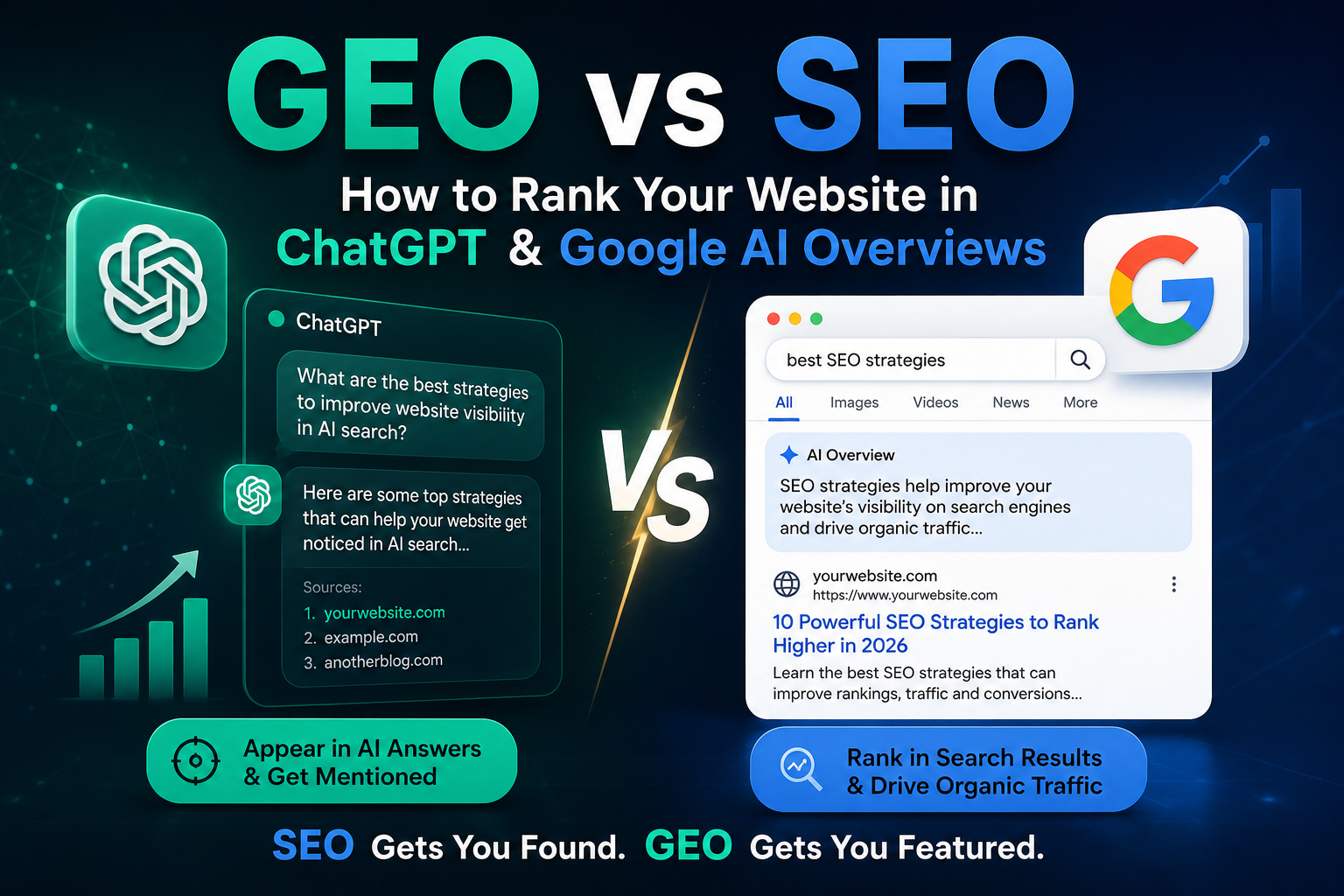
SEO helps your website rank in search engines like Google.
GEO helps your content appear inside AI-generated answers.
But here is the most important point:
SEO is not dead.
It is just changing.
If you run a blog, business website, eCommerce store, or agency website, you now need both SEO and GEO. Otherwise, your content may rank on Google but still be ignored by AI search engines.
In this blog post, we will understand what GEO is, how it is different from SEO, and how you can optimize your website for ChatGPT and Google AI Overviews.
What Is SEO?
SEO means Search Engine Optimization.
It is the process of improving your website so search engines can understand, rank, and show your content to users.
In simple words, SEO helps your website appear on Google when someone searches for a keyword.
For example, if you write a blog on:
“Best AI tools for digital marketing”
Traditional SEO focuses on things like:
Keyword research
Title optimization
Meta description
Internal links
Backlinks
Website speed
Mobile-friendly design
Helpful content
User experience
The goal of SEO is simple.
You want your page to rank higher on Google search results.
What Is GEO?
GEO means Generative Engine Optimization.
It is the process of optimizing your content so AI tools can understand it, trust it, and use it in their answers.
GEO is not only about ranking at number one.
It is about becoming a source that AI tools can mention, summarize, or recommend.
For example, when someone asks ChatGPT:
“What is the best way to use AI in digital marketing?”
ChatGPT may answer by using information from trusted websites, articles, docs, and online sources.
If your content is clear, useful, well-structured, and trustworthy, AI tools have a better chance of picking it.
That is GEO.
GEO vs SEO: What Is the Main Difference?
The main difference between GEO and SEO is the way users receive information.
In SEO, users see a list of links.
In GEO, users see a direct answer.
SEO is about ranking in search results.
GEO is about being included in AI answers.
SEO works mostly around keywords.
GEO works around topics, context, expertise, and trust.
SEO asks:
“Can Google rank my page?”
GEO asks:
“Can AI understand my content and use it as a reliable answer?”
Both are connected.
You cannot ignore SEO and only focus on GEO. Most AI systems still depend on web content, search indexes, citations, and authority signals.
So the smart strategy is not SEO vs GEO.
The smart strategy is SEO plus GEO.
Why GEO Matters in 2026
AI search is becoming normal.
Users do not always want to visit ten websites. They want quick answers.
This is especially true for topics like:
Digital marketing
AI tools
Product recommendations
How-to guides
Local services
Software comparisons
Business ideas
Health and finance information
Technical tutorials
When AI gives an answer, it may mention a few sources. Sometimes it may not send much traffic. But if your brand appears in AI answers again and again, your authority increases.
This means GEO is not only about traffic.
It is also about brand visibility.
People may not click your website the first time. But they may remember your brand name. Later, they may search you directly.
That is powerful.
Is SEO Dead Because of AI?
No, SEO is not dead.
This is a common misunderstanding.
SEO is still the foundation. Google still needs to crawl, index, and understand your website. AI search tools also need reliable information from the web.
But old SEO tricks are becoming weak.
Keyword stuffing does not work.
Thin AI content does not work.
Fake expertise does not work.
Random backlinks do not work.
Copy-paste content does not work.
Modern SEO is moving toward helpful content, real experience, clear structure, and authority.
And these things also help in GEO.
So instead of saying “SEO is dead,” we should say:
SEO is becoming smarter.
How Google AI Overviews Select Content
Google AI Overviews are designed to give users a quick summary for certain searches.
Google may use content from different web pages to create these answers. That means your page needs to be easy to understand, trustworthy, and helpful.
To improve your chances, focus on these things:
Clear headings
Direct answers
Helpful explanations
Original examples
Updated information
Strong author trust
Good technical SEO
Structured content
Fast website experience
Google does not guarantee that your website will appear in AI Overviews. But if your SEO basics are strong, your chances improve.
How ChatGPT Search Finds Websites
ChatGPT Search also uses different signals to find reliable and relevant information.
Your website should be crawlable. That means AI search bots should be able to access your content.
Your content should also be clear and useful. If your site blocks important crawlers, hides content, or has poor structure, AI tools may not use it properly.
For website owners, this is now important:
Allow search crawlers
Keep pages indexable
Use clean HTML structure
Avoid hiding main content behind scripts
Publish helpful and original content
Keep your information updated
If your website is not accessible, even great content may stay invisible.
How to Optimize Your Website for GEO and SEO
Now let’s come to the practical part.
Here are the steps you can follow.
1. Write Clear Answers at the Start
AI tools love clarity.
If your blog answers a question, give the answer early.
Do not force the reader to scroll too much.
For example, if your heading is:
“What is GEO?”
Start with a direct answer:
“GEO means Generative Engine Optimization. It helps your content appear in AI-generated answers from tools like ChatGPT and Google AI Overviews.”
After that, explain with examples.
This helps both humans and AI.
2. Use Question-Based Headings
People ask AI tools questions.
So your headings should match real questions.
Instead of writing:
“GEO Information”
Write:
“What Is GEO?”
“How Is GEO Different from SEO?”
“How Can I Rank in ChatGPT?”
“How Can I Appear in Google AI Overviews?”
This makes your content easier to understand.
It also improves your chances of appearing in featured snippets, AI summaries, and answer-based search results.
3. Build Topical Authority
One blog post is not enough.
If your website talks about AI and digital marketing, create a full content cluster.
For example:
AI tools for digital marketing
AI content writing tools
AI SEO tools
AI automation for agencies
ChatGPT for marketers
Google AI Overviews guide
GEO vs SEO
AI agents in marketing
Future of blogging with AI
How to humanize AI content
When you cover a topic deeply, your website becomes more trusted.
Google understands your niche better. AI tools also find more related information from your site.
This is called topical authority.
4. Add Real Experience
AI can generate basic information.
But it cannot replace your real experience.
So add your own examples.
For example:
“I tested this method on my blog.”
“I used this strategy for an eCommerce website.”
“In my client project, this worked better than normal keyword stuffing.”
“Here is what I noticed after updating old content.”
This makes your content more human.
It also builds trust.
In 2026, experience is a ranking signal you cannot ignore.
5. Use Simple Language
Do not write to impress.
Write to help.
AI search engines and human readers both prefer clear content.
Avoid heavy words when simple words can explain the idea.
For example, instead of writing:
“Generative discovery ecosystems are transforming visibility mechanics.”
Write:
“AI search is changing how people find websites.”
Simple wins.
Every time.
6. Keep Your Content Fresh
AI and digital marketing change quickly.
A blog post written two years ago may not be enough today.
Update your content regularly.
Add new examples.
Remove outdated tools.
Update screenshots.
Refresh statistics.
Improve FAQs.
Add new internal links.
Check broken links.
Fresh content has more chances to perform well in both SEO and GEO.
7. Use Schema Markup
Schema markup helps search engines understand your content.
For blogs, you can use:
Article schema
FAQ schema
HowTo schema
Breadcrumb schema
Organization schema
Person schema
If you are using WordPress, plugins like Yoast SEO or Rank Math can help you add basic schema.
FAQ schema is especially useful because AI tools and search engines can understand your answers more clearly.
8. Improve Your E-E-A-T
E-E-A-T means:
Experience
Expertise
Authoritativeness
Trustworthiness
This is very important for SEO and GEO.
To improve E-E-A-T, add:
Author bio
About page
Contact page
Real business information
Sources where needed
Original screenshots
Case studies
Client examples
Updated publishing dates
Clear privacy policy
If you are writing on serious topics like health, finance, law, or cybersecurity, trust becomes even more important.
9. Create Content That AI Can Quote
AI tools often prefer content that is easy to summarize.
So write strong, clear lines.
For example:
“GEO is not a replacement for SEO. It is an extension of SEO for AI-powered search.”
This type of sentence is easy to understand and easy to quote.
Use short definitions.
Use clear comparisons.
Use examples.
Use bullet points where helpful.
Use FAQs.
Do not write messy paragraphs with too many ideas in one place.
10. Get Mentioned on Other Websites
GEO is not only about your own website.
AI tools may look at your brand across the web.
So try to get your website or brand mentioned on:
Guest posts
Podcasts
YouTube descriptions
Social media profiles
Business directories
LinkedIn articles
Industry blogs
Press releases
Review websites
Community forums
When your brand appears in different trusted places, it becomes easier for AI systems to recognize you.
This is also helpful for SEO.
11. Optimize for Brand Searches
In the AI era, brand search is very important.
People may first see your name in an AI answer. Then they may search your brand on Google.
So make sure your brand pages are optimized.
You should have:
A clear homepage
About page
Services page
Contact page
Social profiles
Google Business Profile if needed
Consistent brand name everywhere
If your brand is confusing, AI tools may not understand who you are.
12. Add FAQs in Every Important Blog Post
FAQs are powerful for GEO and SEO.
They answer real user questions.
They also help AI tools extract information easily.
For this topic, useful FAQs can be:
What is GEO?
Is GEO better than SEO?
How do I rank in ChatGPT?
How do I appear in Google AI Overviews?
Is SEO still important in 2026?
Add FAQs near the end of your blog post.
Keep answers short and clear.
Common GEO Mistakes to Avoid
Many website owners are making mistakes because they think GEO is a magic trick.
It is not.
Avoid these mistakes:
Publishing low-quality AI content
Using fake author names
Copying competitors
Ignoring technical SEO
Blocking important crawlers
Writing only for keywords
Not updating old posts
Ignoring brand authority
Using clickbait without value
Writing long content with no clear answer
AI search is not looking for noise.
It is looking for useful information.
Best Content Format for GEO and SEO
A strong blog post should follow this structure:
Clear title
Short introduction
Direct answer
Helpful headings
Real examples
Step-by-step guidance
Internal links
External references
FAQs
Strong conclusion
This structure helps readers.
It also helps search engines and AI tools.
GEO vs SEO: Which One Should You Focus On?
You should focus on both.
SEO brings traffic from Google search results.
GEO brings visibility inside AI-generated answers.
SEO helps your pages rank.
GEO helps your brand become part of AI conversations.
If you only focus on SEO, you may miss AI search visibility.
If you only focus on GEO, you may ignore the foundation that AI systems still depend on.
So the best formula is:
Strong SEO foundation plus GEO-friendly content.
Final Thoughts
The future of search is not just about ranking on Google.
It is about being trusted by humans, search engines, and AI tools.
That is why GEO vs SEO is such an important topic.
SEO helps your website appear in traditional search results. GEO helps your content appear in AI answers from tools like ChatGPT and Google AI Overviews.
But both have one thing in common:
Helpful content wins.
If your content is clear, useful, original, updated, and trustworthy, you are already moving in the right direction.
Do not chase shortcuts.
Build authority.
Write for humans.
Structure for AI.
Keep improving your content.
That is how you prepare your website for the next era of search.
FAQs
What is GEO in digital marketing?
GEO means Generative Engine Optimization. It is the process of optimizing your content so AI tools like ChatGPT, Gemini, Perplexity, and Google AI Overviews can understand and use it in their answers.
What is the difference between GEO and SEO?
SEO helps your website rank in traditional search engines. GEO helps your content appear inside AI-generated answers. SEO focuses on search rankings, while GEO focuses on AI visibility and source inclusion.
Is SEO still important in 2026?
Yes, SEO is still important. AI search tools still depend on quality web content, crawlability, authority, and relevance. GEO works better when your SEO foundation is strong.
How can I rank my website in ChatGPT?
To improve visibility in ChatGPT Search, publish reliable and helpful content, keep your website crawlable, update your pages, build authority, and make your content easy to understand.
How can I appear in Google AI Overviews?
You can improve your chances by following SEO best practices, writing helpful content, using clear headings, answering questions directly, improving E-E-A-T, and keeping your website technically strong.